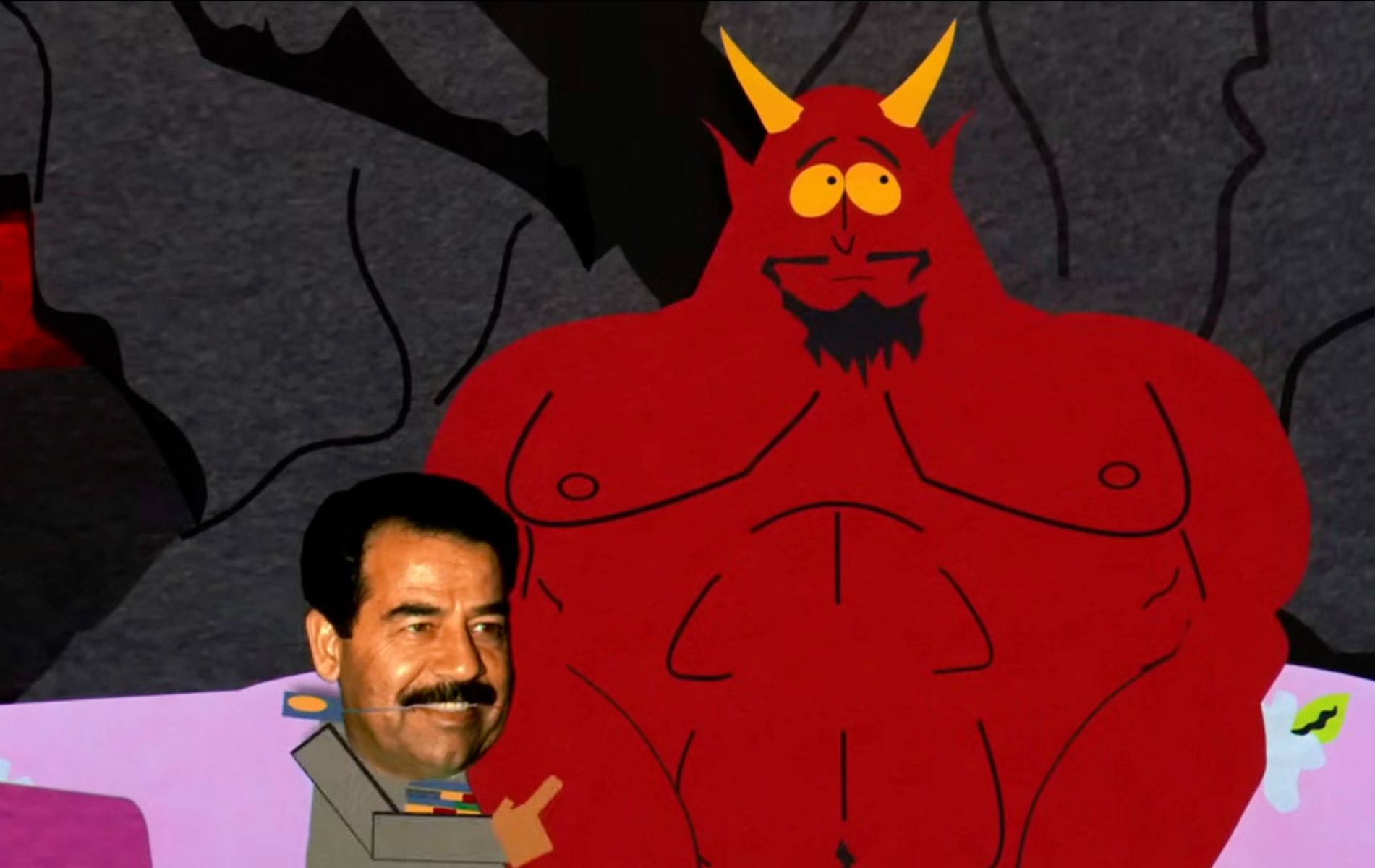
For 30 years, South Park creators Matt Stone and Trey Parker have built their entire brand on doing the thing you’re not supposed to do. So naturally, when they waded into the murky AI waters, they became one of the only companies in the industry actually asking for permission first. Let’s explore that case study in irony a bit.
Some Background
Parker and Stone have built their careers on a single operating principle: If someone tells you that you can’t say something, that’s exactly what you say. To that end, they once portrayed Saddam Hussein as Satan’s boy toy and almost ignited war with their depiction of the Muslim prophet Mohammed. They made a Broadway musical mocking Mormons, which won nine Tonys, which they talk about here. They also made a film with graphic puppet violence and a musical number that remains one of the most aggressively tasteless things ever produced for mainstream cinema.
This credo actually got them pulled off the air by Comedy Central for the Muhammad stunt, then came back the following week and did it again.
Parker reportedly described their career in blunt terms:
All Matt and I have ever done since college is ride into what people are saying you can’t say, and we do it anyway and people throw money at us.
Their Bold Stand
In spite of the iconoclastic role they’ve carved out for themselves, their AI deepfake studio, Deep Voodoo, has somehow become the most ethically rigorous shop in a space not exactly known for its moral compass. This is an industry where the default playbook is to scrape everything, lawyer up, and sort out the mess later. Parker and Stone looked at that playbook and decided to go in a different direction.
So while the rest of the AI industry is operating in full pirate mode—scraping everything in sight, ignoring IP law until forced to stop, and treating actor likenesses as a resource to be mined—Parker and Stone built a company that turns down jobs if the permissions aren’t airtight. In fact, Deep Voodoo won’t work alongside a studio that hasn’t obtained explicit authorization from actors or their estates.
The AI approach that has Hollywood most rattled is the prompt-based model, i.e., type in what you want and the system generates it by drawing on whatever it was trained on, attribution and consent optional…resulting in AI slop like Brad Pitt fighting Tom Cruise to defend Jeffrey Epstein’s honor.
Stone wants no part of any of that. “We’re not doing anything like that,” he told THR. “We’re not typing in a prompt. [We’re] capturing actors doing what they do.” Deep Voodoo’s chief content officer Jennifer Howell made the same point at a film festival panel last year, even more bluntly: “You can’t have a believable performance without an actor.” For Deep Voodoo, the whole model is built around the premise that the human performance is what makes the output worth watching.
If it takes nine cameras capturing 300,000 images and a full month of editing, so be it. If they hafta pepper actors with a flurry of questions to capture the full range of their emotional expressions, cost of doing business. For a duo who once rebuilt an entire production pipeline from scratch just to deepfake a sitting president, meticulous is the baseline.
But is this unexpected? Not really, when you take a deeper look into their m.o. Their rule was never “anything goes with anyone’s content.” The rule was “anything goes with our content.” They push every boundary, but they push their boundaries. The transgression is always personal. They’re mocking their target, making their show, risking their careers. Stone once described their Scientology episode approach in similarly direct terms:
We’re the guys who, if someone says you really shouldn’t do an episode making fun of Scientologists, we say, “Whatever.” Someone says, “They might come try to burn your house down,” we say, “We’ll just get another one.”
So when they turn around and say that using someone else’s face without asking is out of bounds, it tracks. Chaos on their own terms, rules when it’s someone else’s name on the marquee.
What made this entry in my AI Timeline interesting for the broader AI conversation is Deep Voodoo functions as a proof of concept that the consent-first model is actually buildable. The company raised $20 million in 2022 before most of Hollywood was even paying attention to AI. They then went on to work with Kendrick Lamar, Ben Affleck, Billy Joel, and Seth MacFarlane’s Ted. And is now positioned to become a go-to shop as generative AI moves from novelty to production staple. Their approach is slower and more expensive than scraping the web. It’s also, apparently, a viable business.
The rest of the AI industry has spent years insisting that asking permission would be a creativity killer. My ‘legal action’ tag in the timeline has grown to just shy of 200 entries, mostly because of AI companies being sued or investigated for their shenanigans and/or crimes. Apparently consent wasn’t that complicated after all. It just took the creators of South Park to demonstrate it.
Leave a Reply